
octave
-
Posts
4,381 -
Joined
-
Last visited
-
Days Won
58
Content Type
Profiles
Forums
Gallery
Downloads
Blogs
Events
Our Shop
Movies
Everything posted by octave
-
Within science there are often a range of studies. Over time peer review and further studies make things clearer. As a layperson I go with the majority of science sources. Obviously I can't read and analyse this paper myself and I suspect you can't either. I did look at what other scientists say about this study Article: Historical CO₂ levels in periods of global greening Author: Frans J. Schrijver (2025) Main question The paper asks whether today's increase in plant growth ("global greening") caused by rising atmospheric CO₂ implies that past periods with equally lush or greener vegetation must also have had higher atmospheric CO₂ concentrations than those shown in Antarctic ice-core records. SScience of climate change How the author approaches the problem The paper: Starts from evidence that global terrestrial plant productivity (Gross Primary Production, or GPP) has increased by roughly 30% since 1900, largely attributed to CO₂ fertilization. SScience of climate change+1 Uses Mitscherlich's Law (a mathematical model describing diminishing returns in plant growth with increasing nutrients) to estimate how GPP changes with atmospheric CO₂. Applies the model to historical periods believed to have been at least as green as today, including: the Holocene Climate Optimum the Eemian Interglacial the Miocene Compares the CO₂ concentrations that the model suggests would be required with CO₂ estimates from Antarctic ice cores. SScience of climate change Main conclusions The author concludes that: If modern greening is primarily driven by higher CO₂, and if earlier warm periods were similarly or more vegetated, then atmospheric CO₂ during those periods may have been substantially higher than the <300 ppm values indicated by Antarctic ice-core reconstructions. The paper therefore argues that the conventional interpretation of long-term ice-core CO₂ records may underestimate past atmospheric CO₂ during certain warm intervals. SScience of climate change Significance The paper suggests that if its analysis is correct: historical CO₂ variability may have been larger than generally accepted; climate sensitivity to CO₂ could differ from current mainstream estimates; additional evidence beyond Antarctic ice cores should be considered when reconstructing ancient atmospheric CO₂. SScience of climate change Important context This paper presents an argument that differs from the prevailing scientific consensus. The mainstream view, reflected in assessments by the Intergovernmental Panel on Climate Change and much of the paleoclimate literature, is that: Antarctic ice cores provide reliable atmospheric CO₂ records over the past ~800,000 years. Multiple independent proxies (marine sediments, fossil plant stomata, boron isotopes, and others) broadly support the conclusion that pre-industrial CO₂ remained around 180–300 ppm during that interval, despite uncertainties for much older periods. GGMD+2 The Schrijver paper challenges this interpretation by reasoning from vegetation productivity rather than by presenting new direct CO₂ measurements. As a result, its conclusions are not widely accepted and should be viewed as a hypothesis that would require corroboration from multiple independent lines of evidence.
-
I am not a huge gamer myself although I use flight sim. Once a week I connect with my brother in law who lives interstate and we fly our world trip together. We have flown all the way around Australia and NZ. Over the last few weeks we have island hopped to New Guinea where we will attempt some of those insane remote mountain top strips. We usually plan a one hour hop so it is a project that will last for years. We try to use current weather conditions and correct flight planning procedures. There are many games that are a workout for the brain.
-
Yes I was aware of this. My son has a computer games development company. Their flagship games is based on an idea my son had when he was 10. His company now based in NZ employs around 7 people. We are now the poor relatives https://share.google/7DKAr1mzPdrUUSidR
-
Drilling ice cores. The deeper they drill the further back in time they go. The gas in these ice cores is a sample of the atmosphere at the time. https://climate.mit.edu/ask-mit/how-do-we-know-how-much-co2-was-atmosphere-hundreds-years-ago
-
The highest atmospheric \(CO_{2}\) level during human habitation was recorded in May 2026, when peak daily readings at the Mauna Loa Observatory reached 433.95 parts per million (ppm). For historical context, \(CO_{2}\) levels were stable at around 280 ppm for 6,000 years of civilization and never exceeded 300 ppm during the last million years. [1, 2, 3]
-
The thing with naming is it can be difficult to avoid repetition and have something interesting. Many businesses make up words. There was a time when once a week for work I would stay in a cheap motel. The chain of motels was called Formule One. No I did not misspell that. All these years later it sticks in my mind. Sometimes a business name will be a portmanteau. If a business or gallery uses perhaps some ancient Viking word from a language that is no longer spoken, is that really problematic?
-
So would the same apply to perhaps names derived from very early English. Perhaps place names in a language is no longer speaks. What would be an alternate name for these galleries? It just seems a bit boring and stuffy for everything to have English names. I guess we will just have to disagree on this.
-
Surely after white settlement Aborigines developed words for new things introduced by settlers. Prior to settlement I imagine that Aborigines had never seen a horse or camel but I imagine just like any language it develops new words for new things. Often perhaps in this case the word may be the same as English or perhaps similar. In the case of Naala Badu it supposedly means "seeing waters" which refers to the view. This seems relevant to the location. Am I missing something here?
-
I don't really see the problem here. I am sure there are British place names from old English and probably have changed over time. I search the name of the village I lived in Mongarlowe. As far as I know there are no other towns with that name. Yes it is probably is not pronounced accurately. Do people have a problem with Woolomaloo?
-
"Does it matter OT" Sorry OT I meant OME
-
Does it matter OT? Personally I am proud of our mix of historic British words and the historic indigenous words that make Australia different from the US or Canada or NZ or Britain.
-
Only half of petrol tax is going back into roads say motoring groups, amid calls to cut fuel excise
-
It reminds of when we visit our son in NZ. One of our favourite places to visit is Te Papa Tongarewa which is Wellington museum. The literal translation is "container of treasures" I think it is a great name being both an understatement and a name that is quintessentially NZ.
-
This is pretty impressive: an electric mining truck that does not need to be charged. Note, though, that it only works in a specific setting. The trick is that it travels uphill empty and downhill fully laden. Through regenerative braking, it generates more than is required to travel uphill again (empty)
-
I guess what is new are battery-powered trucks and autonomous trucks, such as in China and Canada.
-
Many Australian place names are Aboriginal. I think the only difference here is that this particular name may not have been as commonly used. Despite not being fluent in any other language I have had no problem coping with the places I have lived. Kurrajong, Mongarlowe, Budawang and Geelong.
-
Meanwhile in China
-
I believe there are electric vehicle operating in mines in Australia right now. Battery-electric mining vehicles are operating in Australian mines today, but battery-electric haul trucks are mostly still in the trial or early deployment stage. Already operating today Fortescue is operating: 16 electric excavators in the Pilbara Electric drill rigs Various smaller electric mining equipment being tested and introduced into service Fortescue says each electric excavator saves about one million litres of diesel per year. Battery-electric locomotives are also now being commissioned on Fortescue's Pilbara railway. These are not prototypes sitting in a workshop—they are being prepared for operational use on the rail network. Giant haul trucks (the really big ones) This is where things get interesting. BHP, Rio Tinto and Caterpillar are currently trialling two battery-electric Cat 793 haul trucks at the Jimblebar iron ore mine in the Pilbara. These are 240-tonne-class trucks operating in real mine conditions, but they are still part of a formal trial rather than routine fleet deployment. Fortescue has fitted out its first battery-electric Liebherr T264 haul truck and has commissioned a 6 MW fast charger capable of charging a truck in about 30 minutes. However, Fortescue has stated that its first operational battery-electric haul truck is expected to enter service later in 2026. So the answer is: Equipment Operating in Australian mines now? Electric excavators Yes Electric drill rigs Yes Battery-electric locomotives Yes (commissioning/early operation) Small electric mine vehicles Yes 240-tonne battery haul trucks Trialling now Large battery haul truck fleets Not yet The biggest surprise for many people is that excavators may electrify before haul trucks. An excavator works in a relatively fixed location and can be supplied power more easily, whereas a haul truck may need to climb several hundred metres carrying 200–300 tonnes of ore, making battery size, charging speed and mine-site power infrastructure much more challenging. If you're wondering whether these trucks actually make economic sense, the answer appears to be increasingly "yes" for remote mines. A large haul truck can consume several million litres of diesel over its life, so even expensive batteries can be worthwhile if charging infrastructure and renewable power are available. That's one reason companies like Fortescue are pushing so hard—they believe electrification will eventually reduce operating costs as well as emissions.
-
Don't be ridiculous, it obviously means keyboard players 😁
-
Yes that is true. The comment I was addressing was this: So lets see what is going on with mining vehicles and machinery. For many mines, getting renewable electricity for crushers, conveyors, processing plants, camps and offices is relatively straightforward. The really difficult challenge is replacing the huge diesel haul trucks, loaders, trains and other heavy equipment. Where the industry is today Processing plants Many Australian mines are already running a large portion of their fixed equipment on renewable electricity because the power comes from the site's solar, wind and battery systems. This includes: Crushers Conveyors Mills Pumps Processing plants Workshops and accommodation facilities These are the easiest loads to electrify. Haul trucks The giant haul trucks are the biggest diesel users. A single large haul truck can burn millions of litres of diesel per year. The major miners are now trialling battery-electric trucks: BHP and Rio Tinto are jointly trialling 240–250 tonne battery-electric Caterpillar haul trucks at Jimblebar in the Pilbara. Fortescue has developed its own high-power charging systems and expects its first operational 240-tonne battery-electric haul truck to enter service in 2026. Fortescue is probably the most aggressive 5 Fortescue's strategy is not just to build renewable power stations but to electrify the fleet as well. The company is: Building more than 1.4 GW of solar generation in the Pilbara. Installing large battery systems. Deploying battery-electric haul trucks. Operating electric excavators. Testing electric dozers, graders and loaders. Their goal is to eliminate fossil fuels from their terrestrial iron ore operations by 2030. Mining railways are also beginning to electrify. BHP has taken delivery of Australia's first purpose-built battery-electric heavy-haul locomotives for testing on its Pilbara rail network. These locomotives use large battery packs and regenerative braking. How much diesel is still being used? For most Australian mines today: Equipment Renewable/Electric Status Processing plants Often 50–100% renewable electricity Site buildings Often 50–100% renewable electricity Conveyors and crushers Often renewable-powered Light vehicles Increasingly electric Excavators Early electric deployment Haul trucks Mostly diesel, some electric trials Trains Early battery-electric trials Drill rigs Limited electric deployment So when you hear that a mine is "80% renewable", that usually means 80% of its electricity, not necessarily 80% of all its energy use. Diesel trucks can still account for a very large share of total energy consumption. This is one reason critics sometimes argue that mining companies overstate their progress, while the companies respond that the technology for replacing 250-tonne haul trucks is only now becoming commercially viable. The next five years will probably determine whether battery-electric mining fleets become mainstream in Australia.
-
Australia has quite a few mines that either run partly on renewable energy or are among the world's leaders in renewable-powered mining. Very few large mines operate on 100% renewables all the time, but several are regularly achieving 50–90% renewable penetration and occasionally reaching 100% for extended periods. Major Australian mines using renewable energy Mine Commodity Location Renewable Energy System Renewable Share Agnew Gold Mine Gold WA Wind, solar, battery, gas microgrid Typically 50–60%, up to 85–95% at times (Australian Renewable Energy Agency) Bellevue Gold Mine Gold WA Solar, wind and battery hybrid system Designed for ~80–90%; achieved 155 consecutive hours on 100% renewables (Reddit) Kathleen Valley Mine Lithium WA Solar, wind, battery, gas hybrid Around 60–80% renewable energy (The Australian) Mt Weld Mine Rare earths WA Renewable hybrid power system Reportedly exceeded 95% renewable share during one quarter (Reddit) St Ives Gold Mine Gold WA Large solar and wind project under development Expected to provide over 70% of site power (Reddit) DeGrussa Mine Copper/Gold WA Solar farm with battery storage One of Australia's pioneering renewable-powered mines (Australian Renewable Energy Agency) Weipa Mine Bauxite QLD Large solar installation Partial renewable supply (Australian Renewable Energy Agency) Tropicana Gold Mine Gold WA 24 MW solar, 24 MW wind, battery system Significant renewable contribution to mine power (Solar Now) The leaders Agnew Gold Mine Often regarded as the pioneer. It was the first Australian mine to use large-scale wind generation as part of a mine microgrid. The site combines: 18 MW wind farm 4 MW solar farm Battery storage Gas backup It typically obtains 50–60% of its energy from renewables and can reach much higher levels under favourable conditions. (Australian Renewable Energy Agency) Bellevue Gold Mine Currently one of the most ambitious renewable mining projects in Australia. The mine recently reported operating for 155 consecutive hours (over six days) entirely on renewable energy with diesel and gas generators switched off. (Reddit) Kathleen Valley Lithium Mine A good example of a new-generation mine being designed around renewables from the outset rather than adding them later. It uses a large solar-wind-battery system and has reportedly achieved renewable shares above 80% in some periods. (The Australian) An interesting pattern Most of Australia's renewable-powered mines are in remote Western Australia. That's because: Diesel fuel is expensive to transport. Many mines are off-grid. WA has excellent solar resources. Wind and solar can often generate electricity more cheaply than diesel generation. As a result, renewable energy is often adopted primarily for cost savings and reliability rather than environmental reasons alone. The economics can be very attractive for remote mining operations. (Australian Renewable Energy Agency) If you're interested, I can also list the major iron ore mines (BHP, Rio Tinto, Fortescue) and explain how far they have progressed toward running on renewable energy, because the Pilbara iron ore sector is currently undergoing a huge transition.
-
A lot of industries are already exploring renewables and some are already off grid such as parts of the mining industry. As solar and batteries get cheaper, it will be irrational for households to connect to the grid merely to support the grid for the benefit of industry.
-
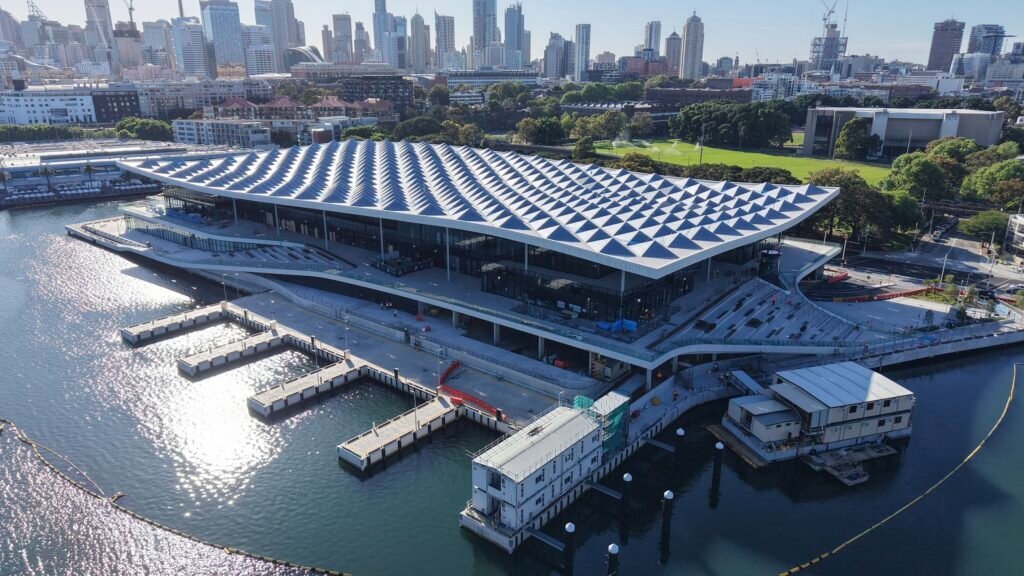
Sydney Fish Market's roof powers the site
octave replied to old man emu's topic in Science and Technology
I think this is a humorous reference to the shape of the roof.
-
I agree, but the thing is that to some people not automatically believing he is innocent equates to "not supporting the troops" My point is that BRS is not the only soldier in this story. Those who beleive BRS is innocent surely must believe that the 20 soldiers who brought this to light must be lying. It will be tested in court.
-
I beleive you can avoid any tax,if you sell it within 2 years and under some circumstances this period may be able to be extended.